System Architecture • API Connections • Platform Sync
Make Your Tools Connect
And Speak the Same Language
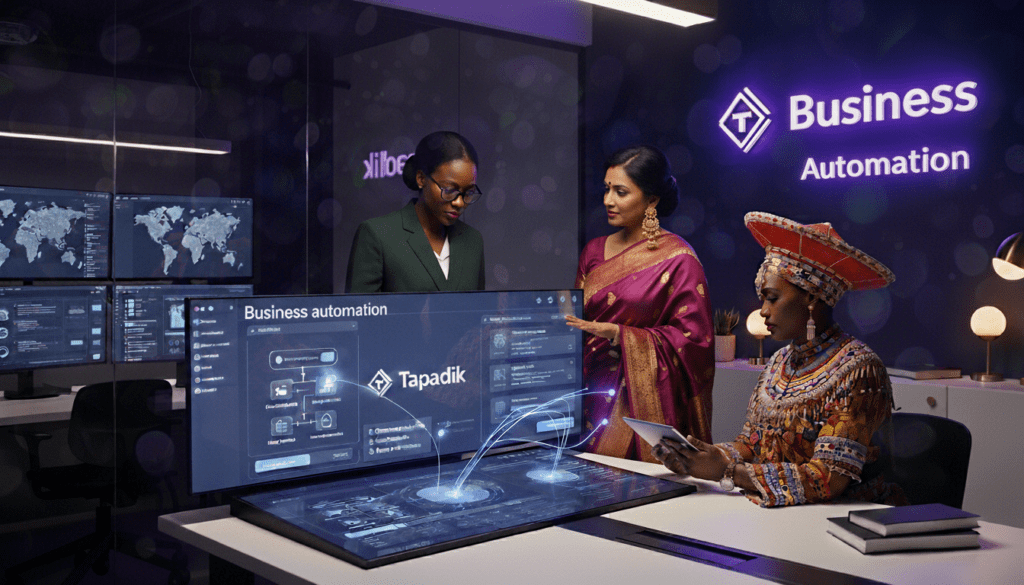
Disconnected platforms cost time and clarity. We architect seamless integrations between your CRM, marketing stack, financial systems, and analytics infrastructure.
API implementation • Data flow optimization • Cross-platform syncing • Secure architecture
Women-led. Systems-driven.
Disconnected systems create delays; integration creates flow.
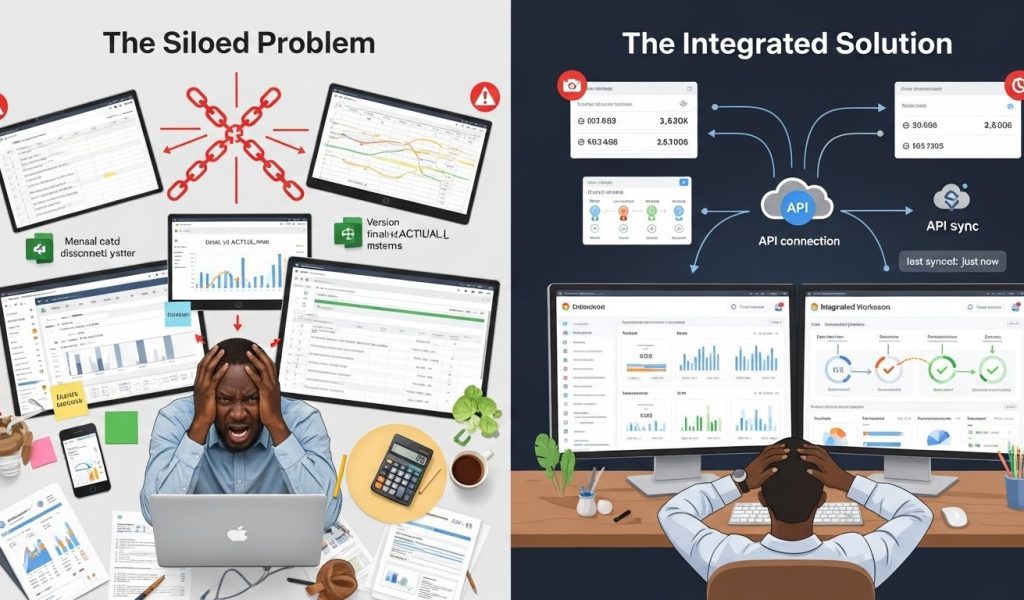
Ask Yourself Before Moving Forward
✔ Do my tools and platforms operate in silos instead of working together?
✔ Am I manually transferring data between systems that should be connected?
✔ Do disconnected systems limit reporting, automation, or scalability?
✔ Would custom integrations reduce friction and create smoother, more intelligent workflows?
✔ Could integrated systems improve accuracy, speed, and operational visibility?
If you answered “Yes” to any of these questions, these “Custom integration” services are designed for you.
Connect Your Business Systems Seamlessly
Connect Your Business Systems Seamlessly
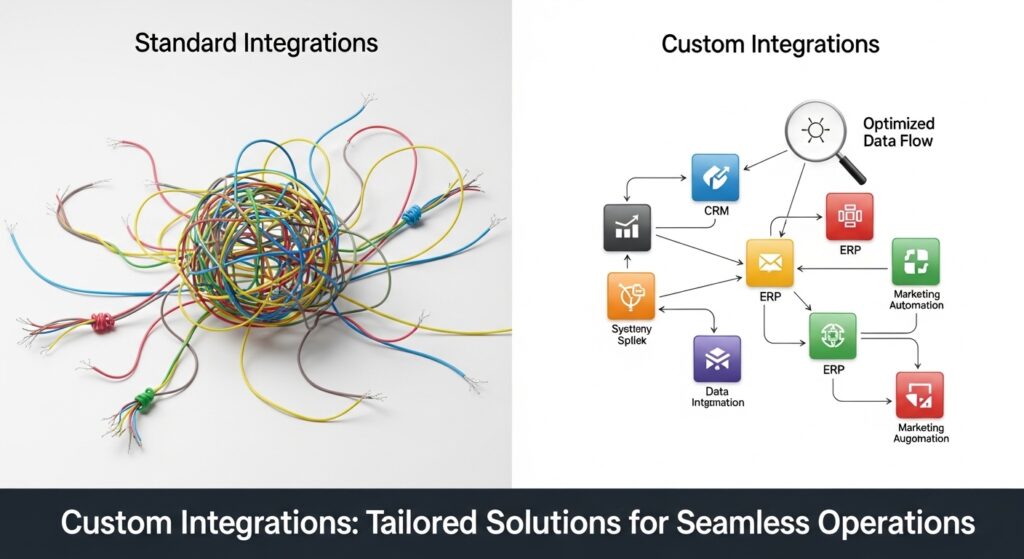
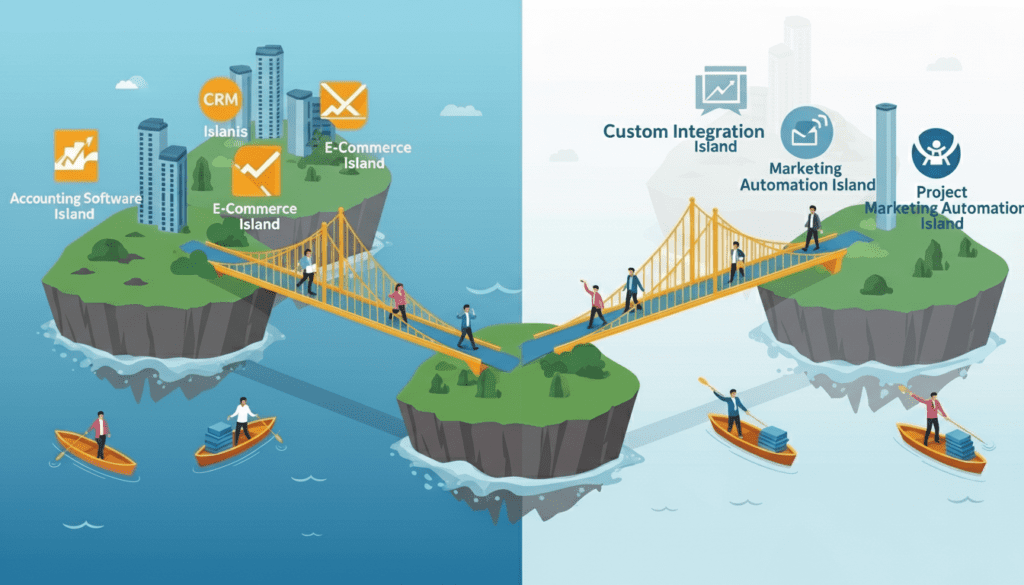
Every business uses multiple software tools—CRM platforms, accounting systems, project management apps, e-commerce solutions, marketing automation, and more. But when these systems don’t talk to each other, you’re left with data silos, manual data entry, and disconnected processes that slow you down.
Custom integrations bridge these gaps, creating a unified technology ecosystem where your systems work together automatically, data flows seamlessly, and your team operates more efficiently.
What Are Custom Integrations and why are they important
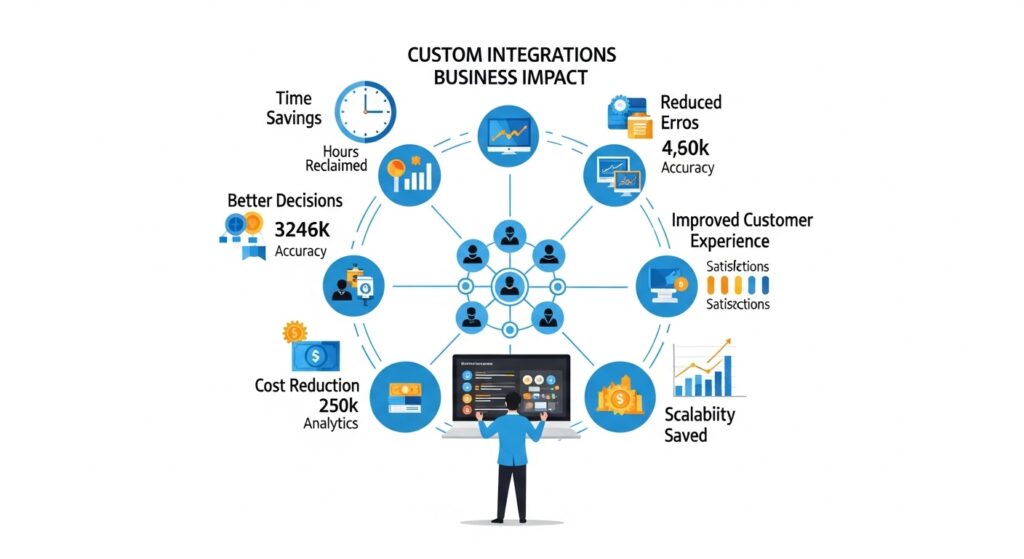
What Are Custom Integrations?
Custom integrations are specialized connections built between your business applications that enable them to share data and trigger actions automatically. Unlike pre-built integrations that offer limited functionality, custom integrations are tailored specifically to your business processes, data requirements, and workflow needs.
Think of it this way: Your CRM knows your customers, your accounting software manages your finances, and your project management tool tracks your work. Custom integrations ensure these systems share the right information at the right time, eliminating manual data transfer and creating a single source of truth across your organization.
Why Custom Integrations Matter
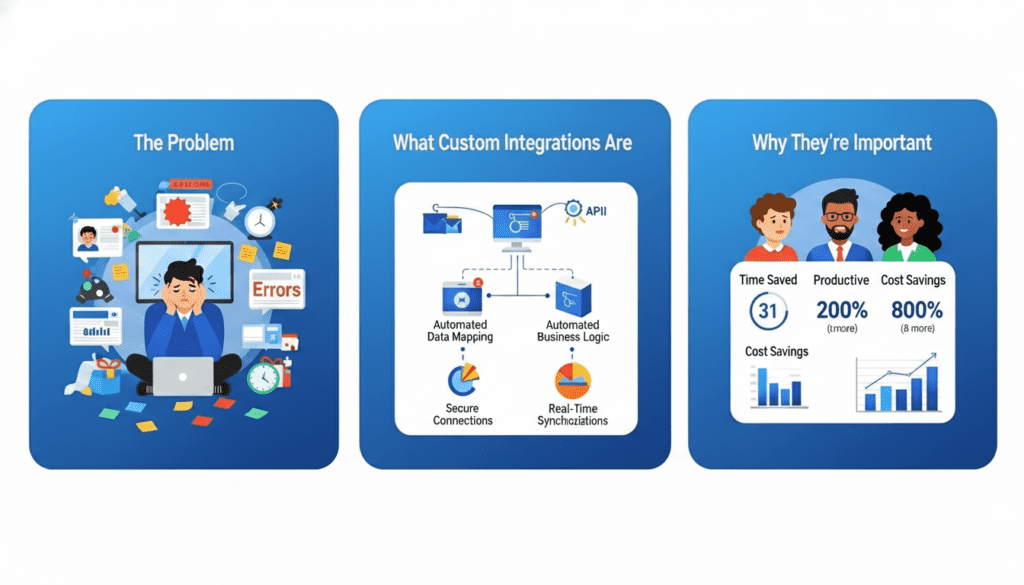
The Cost of Disconnected Systems
When your business tools don’t communicate:
- Data entry happens multiple times – Your team manually enters the same customer information into 3, 4, or 5 different systems
- Information gets outdated – A customer address updated in your CRM remains old in your shipping system
- Errors multiply – Manual data transfer introduces typos, formatting issues, and incomplete records
- Time disappears – Hours each week spent copying, pasting, and reconciling data across platforms
- Decisions suffer – You can’t see the complete picture when data lives in isolated systems
- Customers notice – Inconsistent information and delayed responses damage trust
The Power of Connected Systems
With custom integrations:
- Data flows automatically – Information entered once populates across all relevant systems instantly
- Everything stays synchronized – Updates in one system trigger automatic updates everywhere else
- Accuracy improves – Automated data transfer eliminates human error
- Time is reclaimed – Hours previously spent on manual data work become available for strategic activities
- Insights emerge – Combined data from multiple systems reveals patterns and opportunities
- Customer experience improves – Every team member has complete, current customer information
What We Integrate
What We Integrate
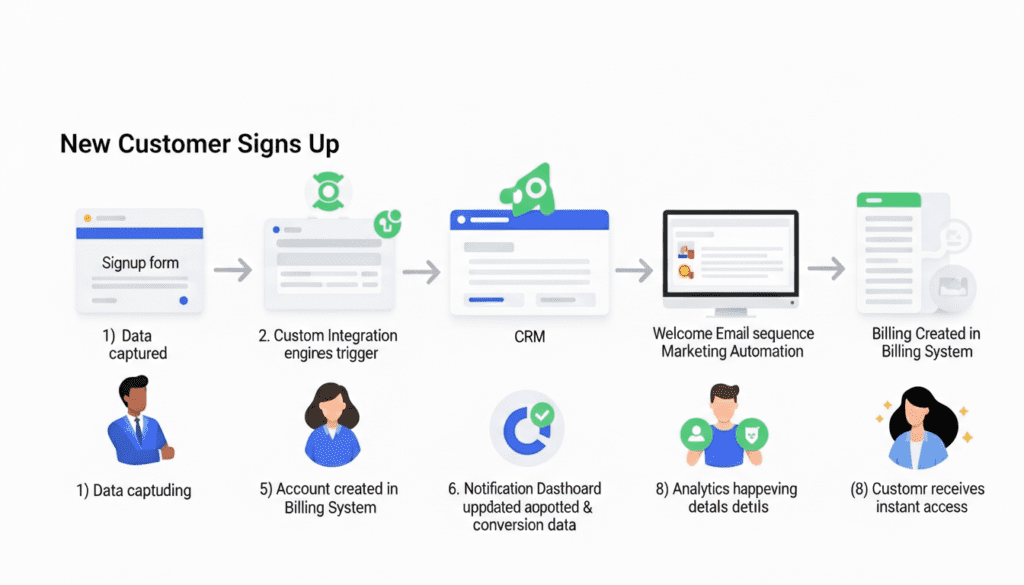
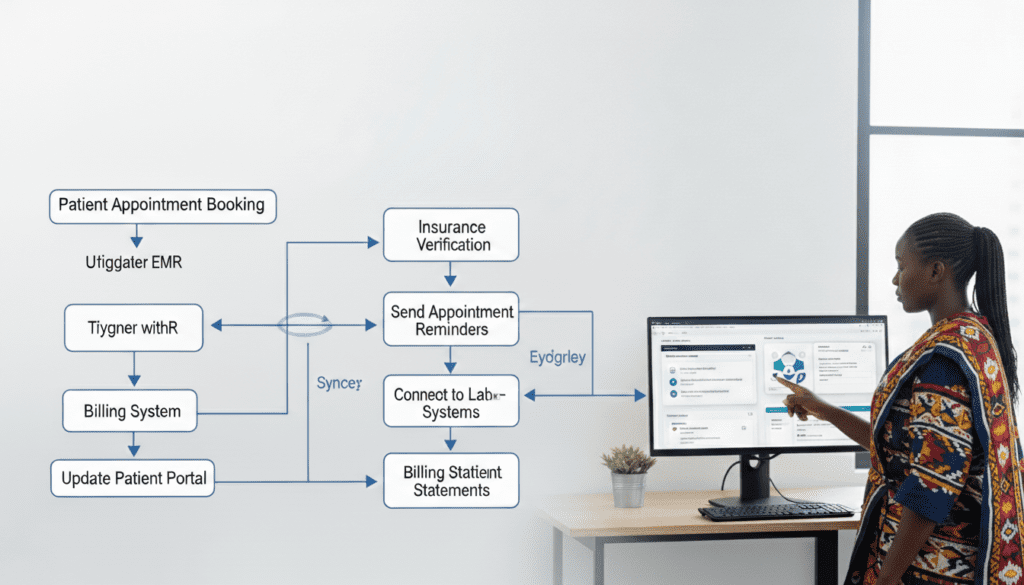
We design integrations across your core business functions, including:
Customer & CRM Systems
HubSpot • Salesforce • Pipedrive • Zoho • Monday
- Automated lead capture
- Pipeline syncing
- Real-time notifications
- Deal tracking & follow-up automation
Marketing & Communication Platforms
Mailchimp • ActiveCampaign • Meta • LinkedIn • WhatsApp Business
- Campaign automation & Contact Syncing
- Segmentation & engagement tracking
- Chatbot → CRM → email workflow syncing
- Email marketing tools
- Form submission & follow-ups
Finance & Accounting
QuickBooks • FreshBooks • Xero • Stripe • PayPal
- Automated invoicing and expense reconciliation
- Approval flows and payment notifications
- Financial dashboards and report automation
Operations & Project Management
- Task creation and status updates
- Workflow handoffs between teams
- Resource tracking and notifications
Administration & HR
Google Workspace • Slack • Notion • ClickUp • Trello • Asana
- Digital onboarding
- Cross-team communication alerts
- Leave management & approvals
- Task automation
E-Commerce
Shopify • WooCommerce • Wix • Etsy
- Real-time order & inventory syncing
- Shipping notifications
- CRM + marketing tool integration
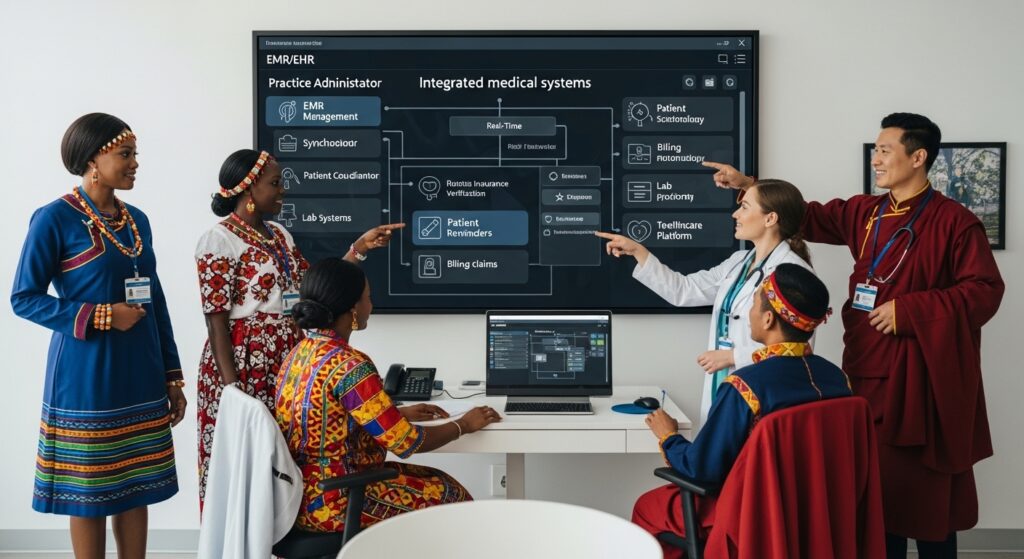
Professional & Healthcare Systems
EHR Systems • Google Workspace • Twilio • Calendly • Airtable
- Appointment scheduling
- Secure form integration (HIPAA-ready)
- Follow-up notifications
Data & Analytics
Google Sheets • Airtable • Power BI • Looker Studio
- Live dashboards
- Automated reporting
- Cross-platform data aggregation
Nonprofit & Commununity
Salesforce NPSP • Airtable • Eventbrite • Mailchimp • WhatsApp Business
- Donor management
- Volunteer scheduling
- Event coordination
- Grant reporting automation
Education & Training
Google Classroom • Moodle • Thinkific • HubSpot CRM • Notion
- Enrollment & progress tracking
- Automated communication
- Certificates & performance dashboards

Ready to Connect Your Systems?
Stop working around disconnected tools.
Let your systems work together—quietly, reliably, and intelligently.
Common Integration Scenarios
CRM to Marketing Automation
The Challenge: Your sales team closes deals in your CRM, but your marketing team manually exports lists to send onboarding campaigns and nurture sequences.
The Custom Integration: When a deal closes in your CRM, the customer automatically enters your marketing automation system with appropriate tags, triggering personalized email sequences, removing them from prospecting campaigns, and adding them to customer-only communications.
Business Impact: Customers receive timely, relevant communications without sales having to notify marketing or marketing having to manually update lists.
E-commerce to Accounting & Inventory
The Challenge: Orders from your online store require manual entry into accounting software and inventory systems, creating delays and potential for errors.
The Custom Integration: Every completed order automatically creates an invoice in your accounting system, updates inventory levels, generates packing slips, creates shipping labels, and triggers reorder alerts when stock runs low.
Business Impact: Orders process faster, inventory stays accurate, accounting records are always current, and you never oversell out-of-stock items.
Project Management to Time Tracking & Billing
The Challenge: Team members track time in one system, but billing requires manually matching time entries to projects and clients for invoicing.
The Custom Integration: Time logged against projects automatically flows into your billing system with correct client assignments, project codes, and billing rates, generating invoices ready for approval.
Business Impact: Billing happens faster, no billable time gets lost, and you gain real-time visibility into project profitability.
Support Tickets to CRM & Project Management
The Challenge: Customer support issues exist separately from sales relationships and product development priorities.
The Custom Integration: Support tickets automatically update customer records in your CRM, create tasks in project management for recurring issues, trigger sales notifications for at-risk accounts, and feed product feedback to your development roadmap.
Business Impact: Sales knows about customer issues immediately, product development sees patterns in support requests, and support has full customer context from CRM.
Form Submissions to Multiple Systems
The Challenge: When prospects submit contact forms, demo requests, or applications, the information needs to reach multiple teams and systems manually.
The Custom Integration: Form submissions simultaneously create CRM contacts, add prospects to email nurture sequences, notify the appropriate sales rep, create tasks in project management, and log the inquiry in your analytics dashboard.
Business Impact: Lightning-fast response times, zero leads fall through cracks, and complete tracking from first contact through conversion.
HR Systems to IT & Payroll
The Challenge: New employees require accounts created across multiple systems, equipment ordered, and payroll setup—all handled manually with multiple handoffs.
The Custom Integration: When HR marks an employee as hired, the system automatically creates email accounts, provisions software licenses, adds them to payroll, creates building access credentials, assigns equipment from inventory, and triggers onboarding workflow tasks.
Business Impact: New employees start with everything ready on day one, IT saves hours per hire, and nothing gets forgotten in the onboarding process.
Event Registration to Communications & CRM
The Challenge: Event registrations require manual list management, badge creation, reminder emails, and post-event follow-up.
The Custom Integration: Registrations automatically update CRM with event attendance, trigger confirmation and reminder emails, generate attendee badges, create follow-up tasks for sales team, and segment contacts based on sessions attended.
Business Impact: Professional attendee experience, automatic sales follow-up on hot leads, and complete event ROI tracking.
Multi-Location Inventory Synchronization
The Challenge: Retail business with multiple locations manually reconciles inventory, leading to stockouts, overstocking, and transfer delays.
The Custom Integration: Real-time inventory synchronization across all locations with automatic transfer requests when one location runs low and another has excess, centralized purchasing triggers, and unified inventory visibility.
Business Impact: Optimal stock levels across all locations, reduced carrying costs, fewer stockouts, and better customer satisfaction.
Some Success Stories

Case Study: Multi-System E-commerce Integration
Client: Growing online retailer with $5M annual revenue
Challenge: Orders from Shopify required manual entry into QuickBooks for accounting, ShipStation for fulfillment, and HubSpot for customer records. Process took 15-20 minutes per order with frequent errors in customer data and inventory levels.
Solution: Custom integration connecting Shopify, QuickBooks, ShipStation, and HubSpot with bidirectional data flow, automated inventory updates, and intelligent customer record matching.
Results:
- Order processing time reduced from 15 minutes to 30 seconds
- 100% elimination of duplicate customer records
- Inventory accuracy improved from 85% to 99%
- Staff time saved: 25 hours per week
- Annual cost savings: $48,000
- Customer satisfaction increased 35% due to faster shipping
Case Study: Professional Services Firm Integration
Client: Consulting firm with 45 employees
Challenge: Disconnected systems for project management (Asana), time tracking (Harvest), CRM (Salesforce), and accounting (Xero) requiring multiple data entry points and manual invoice generation.
Solution: Comprehensive integration connecting all four systems with automated project creation from won opportunities, time tracking linked to projects, and automatic invoice generation with proper client and project coding.
Results:
- Invoice generation time reduced from 8 hours to 30 minutes monthly
- Billing accuracy improved to 99.8%
- Project profitability visibility in real-time
- Client billing disputes reduced by 90%
- Consultants spending 15% more time on billable work
- Annual revenue increase: $250,000 from better time capture
Case Study: Healthcare Practice Integration
Client: Multi-location medical practice
Challenge: Patient management system, billing software, insurance verification, and patient communication tools operating independently, causing appointment scheduling conflicts and billing delays.
Solution: HIPAA-compliant custom integration connecting practice management system, billing, insurance verification API, and patient communication platform with real-time synchronization.
Results:
- Appointment scheduling errors eliminated
- Insurance verification automated (previously 20 min per patient)
- Billing submission time reduced by 60%
- Payment collection improved by 28%
- Staff administrative time reduced by 18 hours weekly
- Patient satisfaction scores increased by 42%
How Global Leaders Win With Custom Integration
The world’s most successful companies don’t rely on more software—they connect their systems intelligently. Custom integration is what allows global brands to operate at scale, deliver seamless experiences, and grow without chaos.
Uber — Real-Time Operations at Massive Scale
Uber connects rider apps, driver apps, maps, payments, support, and analytics into a single integrated ecosystem. Every trip automatically triggers routing, pricing, payments, notifications, and tracking—instantly and reliably.
Why it matters: Without integration, Uber’s model would fail. Seamless operations depend on systems talking to each other in real time.
Spotify — Personalized Experiences for Hundreds of Millions
Spotify integrates listening behavior, preferences, payments, recommendations, and royalty calculations. Every interaction updates multiple systems automatically across devices and platforms.
Why it matters: Even complex, data-heavy experiences can feel effortless when systems are properly integrated.
Tesla — One Connected Production & Service Ecosystem
Tesla links manufacturing, inventory, diagnostics, software updates, sales, and service scheduling into a unified system. A single service request triggers diagnostics, parts availability, scheduling, and billing.
Why it matters: Integration removes friction, eliminates middle layers, and improves both operations and customer experience.
DoorDash — Real-Time Coordination Across Multiple Stakeholders
DoorDash integrates restaurant POS systems, driver apps, payments, maps, and notifications. Orders flow automatically from request to fulfillment with real-time updates for everyone involved.
Why it matters: Modern service businesses depend on integration to function at speed.
Salesforce & Stripe — The Backbone of Scalable Business
Salesforce connects marketing, sales, billing, support, and analytics for over 150,000 companies worldwide. Stripe integrates payments, subscriptions, fraud detection, accounting, and banking—processing hundreds of billions annually.
Why it matters: If global enterprises rely on integration to manage complexity, the same principles apply—at any scale.
Ready to Connect Your Business Systems?
Stop wasting time on manual data entry and disconnected systems. Let’s build custom integrations that make your technology work together seamlessly.